Zero till wheat
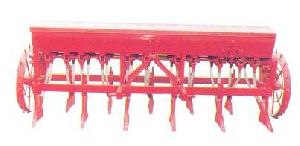
Traditional foundation of wheat after rice includes evacuation of the rice deposits (dominatingly by consuming in north-west India, or physically in eastern India), trailed by escalated culturing (Gajri et al., 2002). In the north west, this commonly includes a pretillage water system pursued by a few discings then harrowings then plankings to set up the seed bed for wheat. In Punjab, India the seed is regularly sown in lines by a seed drill, while in Haryana and the eastern IGP it is ordinarily communicated. Reception of zero culturing in the IGP has been fast since the mid-1990s, expanding to more than 3 million hectares by 2006 (Harrington and Hobbs, 2009). The significant driver for selection is expanded gainfulness because of lower foundation costs (Erenstein and Lakshmi, 2008). In 2003– 2004, zero till wheat (ZTW) was rehearsed on more than 1 million hectares in India, utilizing the Pantnagar or "zero till" seed drill (Erenstein and Lakshmi, 2008). This machine is equipped for sowing into uncovered, nontilled soil and into tied down rice buildups, yet not into consolidate reaped rice stubbles in light of the fact that the free deposits left by the collector hinder the seed drill. In this way ZTW as it is as of now rehearsed includes full or incomplete consuming, or expulsion of the free rice buildups.
In an exhaustive audit of ZTW rancher participatory preliminaries and research in RW frameworks of the IGP, Erenstein and Lakshmi (2008) discovered that zero till spared one water system, and gave normal water system water investment funds of 10– 30% or up to 100 mm, contrasted and regular culturing. This was for the most part because of absence of requirement for a presowing water system due the capacity to sow sooner after rice collect while the dirt was as yet wet, and because of the a lot shorter term of the main water system in light of the quicker development of the water over the nontilled soil surface. In any case, a pre-culturing/sowing water system may not generally be required for wheat sown into worked soil (Sharma and Singh, 2002). Yields of ZTW were comparative or higher (by a normal of 6%) than yields with ordinary culturing, along these lines WPI was likewise higher. Selection ponders in Haryana (Erenstein et al., 2008) additionally demonstrated that WPI was altogether (17%) higher in ZTW than with regular culturing, because of somewhat higher yields (by 4%) and marginally bring down water system sum (by 9%), in spite of the fact that the normal number of water systems for both foundation strategies was the equivalent.